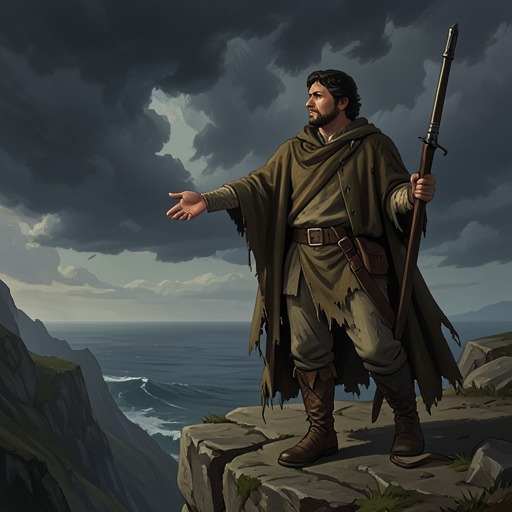
Knight-errantry
Don QuixoteKnight-errantry is the vocation Don Quixote adopts when he turns the reading of chivalric romances into a program for life: he will roam in armor, seek adventures, right wrongs, aid people in distress, and win lasting fame. In the novel it is at once an ethical ideal, a self-fashioned identity, and a comic means of misreading the world. Cervantes’s distinction is crucial: he does not claim to have abolished historical chivalry, which he regards as long dead, but attacks a debased imitation of it. Don Quixote’s conviction preserves the ideal’s language of service even as his attempts to enact it repeatedly collide with ordinary circumstances.
A Vocation Built from Books
Don Quixote’s profession begins in a collapse of the boundary between reading and action. His wits gone, he decides that his own honor and the service of his country require him to become a knight-errant. He will travel the world in full armor and on horseback, put into practice what he has read about knights, expose himself to danger, and earn renown. In his imagined future, valor may raise him to an emperor’s standing; the scale of the ambition is part of the romance through which he now interprets his life. His decision is not merely to admire heroic stories but to enter their world as their next exemplary actor.
The transformation is also material and performative. Don Quixote has his armor cleaned, turns his morion into a helmet, and gives his horse a new name before concluding that a knight needs a lady to love. He conceives of that devotion as integral to the role, not an optional private attachment: a defeated giant should be sent to the lady to submit to her, thereby linking combat, homage, and the knight’s public reputation. The elaborate imagined scene makes visible how completely he treats the conventions of books as rules for real conduct.
His first declared purpose is to travel wherever there are adventures, and to act for people in distress. Before setting out, he insists that his mission is to right wrongs and redress injuries. The language gives his private delusion a public and moral shape: the knight is not supposed to fight merely for the pleasure of combat, but to convert force into help. Later he describes his calling as opposing oppression and assisting those in need. The discrepancy between these claims and the results of his interventions supplies a recurring tension: the ideal’s ends may be generous even when his judgment of what is happening proves unreliable.
Duties, Rules, and Models
Don Quixote gives the vocation an expansive history and an exacting code. He tells the goatherds that knights-errant arose to defend maidens, protect widows, and succor orphans and the needy. He claims this profession for himself and imagines its practitioners as agents who bring justice into the world through action. In his account, the wandering knight serves people whom social arrangements have left exposed; the duties of the calling therefore include defending the vulnerable as well as confronting the powerful.
The profession also has rules that govern how its members and companions should behave. Near Puerto Lapice, Don Quixote instructs Sancho Panza not to draw his sword in a fight between knights unless he has first been dubbed a knight himself. That restriction matters because Sancho’s practical assistance is subordinate to the imagined legal order Don Quixote obeys. The code can authorize a knight’s intervention while at the same time limiting the help available to him. Its elaborate form gives Don Quixote a way to interpret danger and assign roles, even when those rules have no authority over the people he encounters.
Romance supplies the models by which he measures his own performance. Don Quixote places Amadis of Gaul above other knights and treats him as the exemplar a practitioner should imitate, much as an aspiring painter studies the greatest masters. He also invokes the names and deeds of celebrated figures such as Don Belianis of Greece, presenting knight-errantry as an established tradition rather than a private invention. For Don Quixote, this inheritance is not safely past: it is a living standard against which the present can be judged and by which the future can be remade.
The calling is not restricted to isolated combat. Don Quixote distinguishes the wandering knight from the courtier: the courtier serves a sovereign through courtly display and hospitality, while the knight-errant explores remote places, endures heat and winter cold, and faces dangers that test courage. He argues that a knight who aids a widow in a lonely place better fulfills his particular role than a court knight occupied with a city lady. His imagined profession depends on mobility, hardship, and exposure; the open road is both its workplace and its proof of commitment.
Don Quixote also ranks arms above letters in honor, while acknowledging that letters may have founded more great houses. To him, arms possess a special distinction because they enact service rather than merely describe it. He even compares the knight’s vocation favorably with poetry. These claims extend the ideal beyond an individual code of conduct: knight-errantry becomes, in his reasoning, a profession with civic, religious, and cultural importance. Its practitioners carry out in the world what others may pray for, and their labor makes them instruments of justice. The grandeur of this account explains both the force of his commitment and the gulf between it and the world that does not share its premises.
The Ideal on the Road
The novel repeatedly tests knight-errantry through encounters in which Don Quixote recognizes a familiar romance pattern but other people see a different situation. After attacking a funeral procession at night, he explains the event as a consequence of its mourners’ dress, torches, and prayers, which made them appear to him as beings from another world. He says that his duty required an attack even if he had known them to be devils. The episode shows how the code can turn mistaken perception into an obligation: once he has assigned an encounter a chivalric meaning, restraint can seem like a failure of duty.
When Don Quixote meets a group of condemned galley slaves, he interprets their distress as a case for his office: he must suppress force and help the wretched. After hearing their accounts, he reasons that some may have been punished through poverty, lack of advocacy, torture, or a judge’s perverted judgment. He understands their forced journey as oppression and acts under the vow to aid people under the strong’s power. Yet he also speaks as if knight-errantry exempted him from ordinary jurisdiction. When officers of the Holy Brotherhood seek to arrest him, he claims that a knight’s law is his sword and that his profession confers privileges unavailable to other people. His defense exposes a sharp contradiction: a vocation conceived as justice for the powerless can become, in his own hands, a claim to stand outside the law.
A different trial comes when Don Quixote attacks lions carried in a cage. He later explains that the wandering knight’s task is to face dangers, and that courage lies between cowardice and rashness, while conceding that the attack approached rashness. This reflection gives the ideal some capacity for self-scrutiny: valor is not simply the absence of fear, and the knight can recognize excess even while defending the duty that led him into danger. His account to a traveller places this episode among the repeated falls and recoveries of his career. He says he has left home, mortgaged his estate, surrendered comfort, and entrusted himself to Fortune in hopes of reviving a profession he considers dead.
The promise of fame is one reason he persists. Sancho points out that adventures in wild places may go unseen and therefore remain unrecorded; service under an emperor or prince might bring both recognition and reward. Don Quixote accepts the practical force of this point but insists that the knight must first earn a reputation through deeds on the road. Only then can he arrive at court already known, with stories of defeated giants and released captives preceding him. The exchange sets Sancho’s material and documentary concerns against his master’s romance of fame: the same deeds are, for one, a route to measurable reward and, for the other, the necessary prehistory of immortal renown.
Failures, Persistence, and the Historical Contrast
The ideal’s failures do not simply erase it from Don Quixote’s mind. At home, after a period of fifteen quiet days without an outward sign that he intends to resume his former delusions, he debates knight-errantry with the curate and the barber. He continues to maintain that the world needs knights and that its revival is to be accomplished through him. The curate sometimes contradicts him and sometimes agrees, because direct opposition would make it harder to bring him to reason. Even in apparent repose, then, the profession remains the central argument through which Don Quixote understands what the world lacks and what his life should do.
Its language returns across later adventures. At the castle, Don Quixote offers to challenge and kill Malambruno if doing so will relieve the distressed women who appeal for help. He makes the promise in the vocabulary of rescue and redress, treating the predicament as another occasion to prove the profession’s capacity for service. On another occasion, he refuses assistance from attendants who would undress him, preferring to sleep in his clothes rather than place a barrier between his inclinations and his virtue. The episode connects the knight’s public code to personal discipline: even hospitality is assessed according to whether it threatens the identity he has pledged to maintain.
When Altisidora’s companions stage a disturbance with a cord and bells and cats, Don Quixote interprets the commotion as the work of malignant enchanters. He draws his sword, identifies himself as Don Quixote, and attacks the cats as though defending himself against an assault on his vocation. The scene shows the code’s persistence under ridicule and deception: he continues to assign himself the role of the threatened knight, while others understand the episode as a prank. His conviction can make him vulnerable, but it also supplies the continuity that carries him from one adventure to the next.
Cervantes’s historical distinction prevents the novel’s comedy from being reduced to an attack on chivalry itself. The account says that Spanish chivalry had been dead for more than a century, its work finished with the fall of Granada, and argues that it could not survive under the political order Ferdinand substituted for the free institutions of medieval Spain. On this reading, the object of Cervantes’s satire is not the old ideal but a degrading mockery that persists after the social conditions that once sustained chivalry have disappeared. Knight-errantry consequently occupies two different historical positions: it is the imagined means by which Don Quixote would restore a lost moral order, and the delusion through which the novel exposes a hollow imitation of that order.
Narrative and Ethical Significance
Knight-errantry organizes the novel as both a repeated motive and a source of conflict. Don Quixote’s profession supplies a ready purpose for travel, a vocabulary for interpreting strangers, and a reason to accept danger. It also makes each new event legible to him as an opportunity for rescue, combat, or renown. Because the surrounding world does not reliably confirm his readings, the same vocation can produce an attempted defense of the vulnerable, an attack on people he mistakes for supernatural enemies, or a confrontation with civil authority. The episodes do not yield a simple verdict on the ideal; instead, they distinguish the declared duty from the unreliable judgments through which Don Quixote tries to fulfill it.
Its ethical force is clearest when he attends to another person’s vulnerability. He calls the release of captives, assistance to the miserable, and relief of the needy proper works of his profession; he offers to defend a woman whose promised marriage has been broken and says that the calling requires protection of the humble and chastisement of the proud. In each case, the language of service places an obligation on the person who claims the title of knight. But the novel sets that obligation beside his self-authorization, his disregard for ordinary jurisdiction, and his readiness to treat mistaken appearances as proof. The contrast asks not only whether he is sincere, but whether good intentions can reliably become justice when perception and authority are so unstable.
Don Quixote’s reflections on freedom deepen that contrast. After leaving the castle, he tells Sancho Panza that captivity is a great evil and that freedom is a precious gift, explaining that even abundant food brought little satisfaction when he could not enjoy it freely. His attachment to self-direction echoes the knight’s refusal to treat comfort or security as a substitute for chosen service. Yet the ideal remains inseparable from the costs of his choices: he has given up comforts, mortgaged his estate, and made himself answerable to an imagined code. Knight-errantry is therefore both liberation from an ordinary life and a discipline that binds its adherent to a demanding role.
The ending implied by Don Quixote’s own reflections is less a completed restoration than an unresolved hope. He interprets the saints and knights depicted in images as members of the same profession of arms, though they fought with divine weapons and he with human ones. He cannot say what his own sufferings have won; he can only wonder whether Dulcinea’s release from her enchantment might allow him, with better fortune and a restored mind, to take a better path. The thought retains his characteristic belief in release and renewal while acknowledging uncertainty about the meaning of his trials. Knight-errantry remains powerful because it joins an aspiration to aid others with the peril of mistaking one’s own imagined world for the one in which that aid must actually be given.